By Clive Horan, Head of Professional Services, CAD-IT
When engineering data, technical publications and service information aren’t connected, manufacturers pay for it in repeat visits, wrong parts and lost uptime. Here’s where the gap comes from, what it’s really costing you, and what changes when you close it.
A field service engineer arrives on site. The customer’s line has been down since six that morning. She opens the parts catalogue on her tablet, finds the exploded view, identifies the failed bracket and confirms the part number. The replacement was ordered the night before, so it’s in the van.
It doesn’t fit.
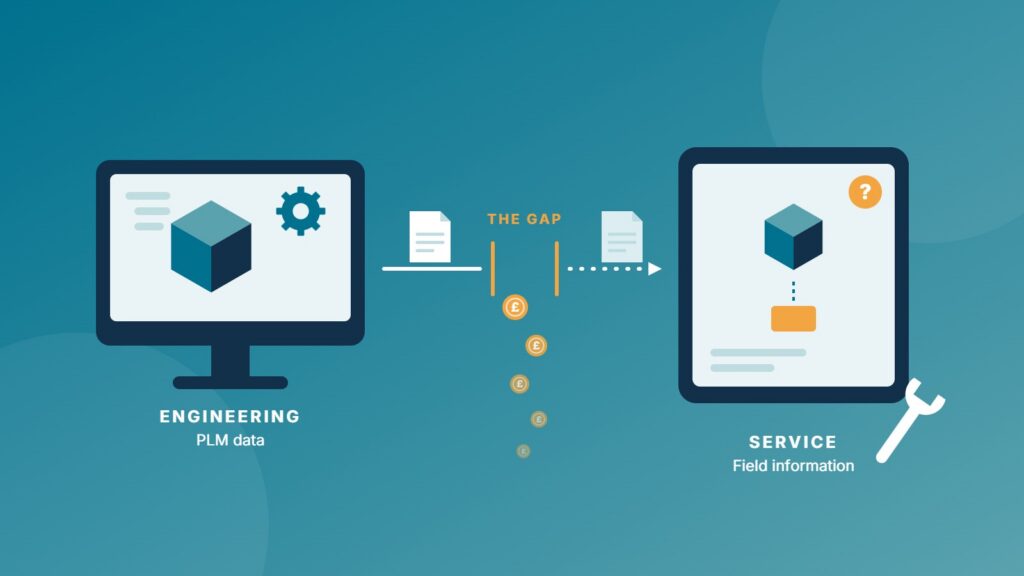
The bracket was redesigned eight months ago. Engineering raised the change, approved it and released it in PLM. Production built to the new design. But the parts catalogue was updated from a separate source, on a separate schedule, by a separate team, and that update hadn’t happened yet. Nobody made a mistake. Every document was accurate on the day it was written.
The manual was right. The machine had changed.
She calls the office, a second part is ordered, a second visit is booked, and the customer’s line stays down for another day and a half. On paper, it’s one failed first-time fix. In reality, it’s a symptom of something much bigger, and much more expensive, that runs through almost every engineering and manufacturing business I’ve worked with.
The cost hides in the gaps
Most organisations measure downtime, first-time fix and parts accuracy. Very few measure the thing that quietly drives all three: whether the information a technician, an author or a customer is using actually matches the product in front of them.
The numbers around it are hard to ignore:
- Downtime is getting more expensive, not less. Siemens’ True Cost of Downtime 2024 estimates unplanned downtime costs the world’s 500 largest companies around $1.4 trillion a year, roughly 11% of their revenue. An hour of downtime in a large automotive plant now costs about $2.3 million.
- Recovery is getting slower. The same report found the average time to get production running again rose from 49 to 81 minutes in five years, partly because experienced people left and took their knowledge with them.
- Technicians spend a lot of their day looking, not fixing. In the Kothes Insight-Report Service 2023, 86% of service technicians said they spend at least 30 minutes a day searching for information, and a third spend an hour or more.
- Missing information creates repeat visits. In that same study, 93% said a lack of access to information had already caused additional service call-outs.

Now put that against where the money is. McKinsey’s analysis across 30 industries found aftermarket services averaged a 25% EBIT margin, against 10% for new equipment. BCG’s 2025 research puts service gross margins at around double the 15–25% typically earned on equipment sales.
In other words, service is where many manufacturers make their best money. And service runs on information. When that information is out of step with engineering, you’re not just losing time. You’re eroding the most profitable part of the business.
Why PLM and service information drift apart
Here’s the uncomfortable truth I share with almost every organisation I sit down with: your PLM system probably isn’t the problem. Neither is your technical publications team. The problem is the handover between them.
Most businesses invested in PLM to control engineering data, and it does that job well. Parts, assemblies, revisions and change orders are managed, approved and traceable. Then, somewhere after release, that control stops. Service information gets built from exports, screenshots, spreadsheets and the knowledge of whoever has been there longest.
It helps to think about technical content as having four stages of life:
- Created. Authors build manuals, parts catalogues, work instructions and training material, often from a snapshot of engineering data taken weeks earlier.
- Managed. That content lives in a CSDB, a CMS, a shared drive or, quite often, all three, with its own versioning that doesn’t talk to PLM.
- Published. Outputs go to PDF, portals or print on a schedule set by the publications team, not by engineering change.
- Consumed. Technicians, customers and dealers use whatever version reached them, with no easy way to know it’s out of date.

At every one of those stages, there’s a gap where engineering can move on without service information following. One change order won’t hurt you. Hundreds a year, across a product range with a 20 or 30-year service life, will.
The symptoms are familiar:
- Parts catalogues showing superseded parts, so the wrong items get ordered and returned
- Authors re-keying data that already exists in PLM, then re-keying it again after the next change
- Service bulletins and manuals that contradict each other
- Field engineers keeping their own notes because they no longer trust the official version
- Nobody able to say with confidence which publications are affected by a given change
None of these show up as a line on the P&L. They show up as longer repairs, repeat visits, returned parts, unhappy customers and authors who spend more time chasing data than writing.
What “connected” actually means
“Connected” is one of those words that gets used so often it stops meaning anything. So let me be specific about what it looks like in practice.
Service lifecycle management is about making sure the information used to maintain, repair and support a product stays true to that product for as long as it’s in service. Connecting it to engineering means three things:
- One source of product truth. Service content is built from the same managed engineering data your designers use, ideally a service bill of materials (SBoM) derived from PLM, rather than a copy of it.
- Change that flows downstream. When engineering releases a change, the affected manuals, catalogues and work instructions are identified automatically, not discovered months later by a technician on site.
- Content built to be reused. Information is authored once in a structured form, then published to whatever format the user needs: an interactive 3D catalogue, a work instruction on a tablet, an S1000D data module or a PDF.
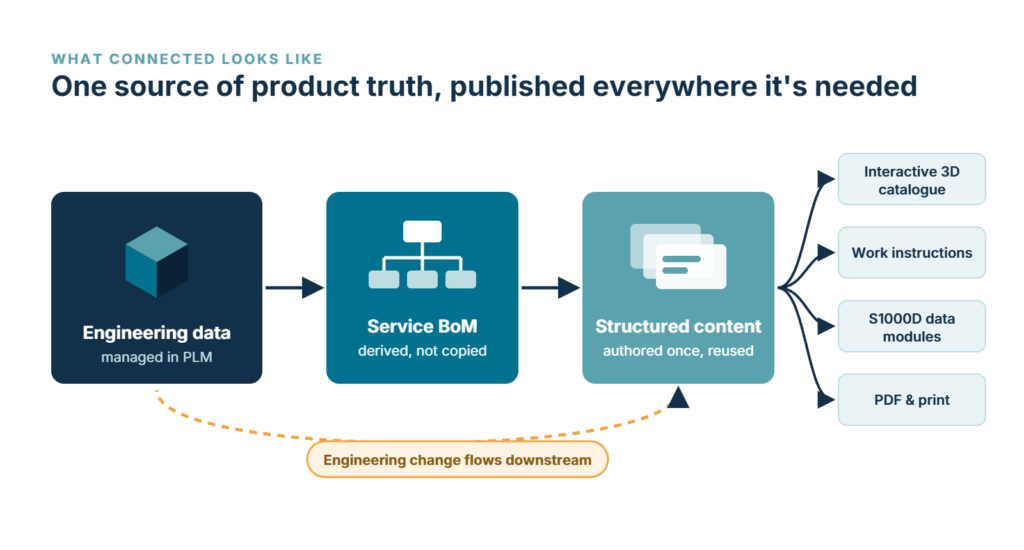
That last point matters more than people expect. When content is structured and reusable, a single engineering change updates every output that uses it. When it isn’t, every output becomes its own maintenance project.
The goal isn’t to turn your publications team into engineers, or your engineers into authors. It’s to let each team work in the tools that suit them, with the data moving between them under control.
What changes when the pieces connect
When I’m asked what a connected approach actually delivers, I don’t start with software. I start with what changes for the people doing the work, and what that’s worth to the business.
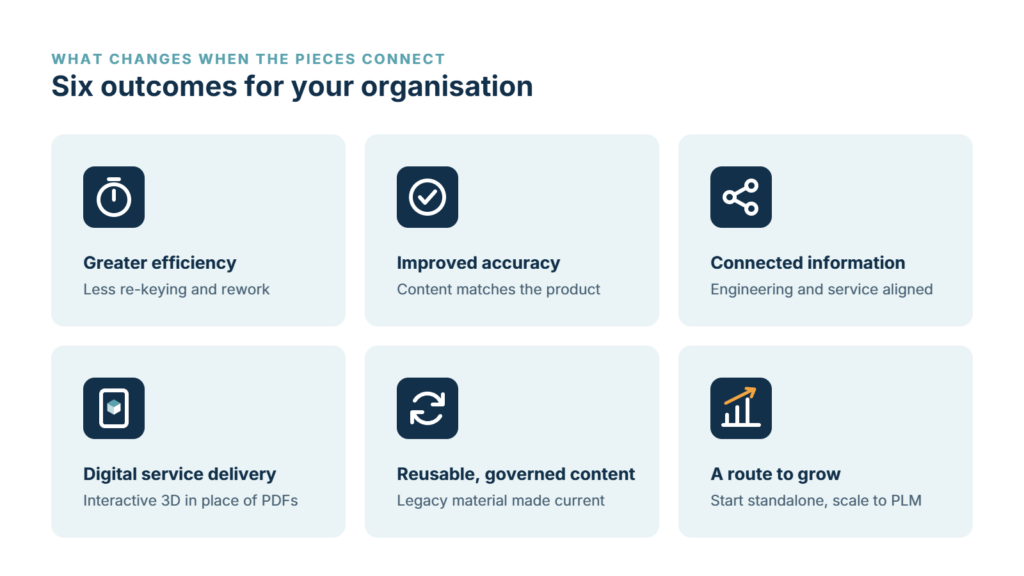
Greater efficiency
Authors stop re-keying data that already exists. Templates and import profiles pull parts and structure straight from engineering, and publishing automation removes the manual steps between a finished draft and a released output. The time saved goes back into better content, not chasing data.
Improved accuracy
This is the one that fixes the bracket problem. When publications are driven by managed engineering data, they stay aligned as the product changes. The right part gets ordered. The procedure matches the machine. Fewer returns, fewer second visits.
Connected information
Technical publications stop being an island. A change in engineering is visible to service. A recurring fault reported from the field can be traced back to a part and a revision. That’s how engineering, service and lifecycle data start informing each other, rather than living in separate worlds.
Digital service delivery
Static PDFs give way to interactive 3D catalogues, manuals and work instructions. A technician can rotate an assembly, isolate a component and see the exact procedure for that serial number. It’s faster to use, easier to understand across languages and skill levels, and far less open to misinterpretation.
Reusable, governed content
Legacy manuals are one of the biggest hidden liabilities in service. Converting them into structured, governed information, ready for interactive 3D authoring, S1000D or PLM-controlled workflows, turns years of accumulated documentation into an asset you can keep current.
A route to grow
You don’t need to do everything at once. The most practical programmes start standalone, delivering interactive catalogues or work instructions from engineering data, and mature into fully SBoM and PLM-controlled service information when the business is ready.
Taken together, these outcomes hit the three numbers that matter most in service: time to repair, first-time fix and cost to serve. And they protect the part of the business with the strongest margins.
Where to start: advice from the field
If this all sounds familiar, here’s what I’d suggest, based on what I’ve seen work and what I’ve seen go wrong.
- Follow one change all the way through. Pick a recent engineering change and trace it to every manual, catalogue, bulletin and training module it should have touched. How long did each update take? Which ones haven’t happened yet? This one exercise usually tells you more than any audit.
- Ask your technicians what they don’t trust. The workarounds, personal notes and “ring Dave” moments point directly to where the information chain is broken.
- Put a number on it. Repeat visits, wrong parts returned, hours spent re-keying data. You don’t need precision, just enough to make the case that this is a business problem, not a documentation one.
- Start where you are. If you already run Teamcenter, the question is how to get more from that investment by extending it into service. If you already use Cortona3D or RapidAuthor, the question is how to upgrade, extend or integrate. If you have neither, a standalone interactive catalogue or work instruction project can deliver value quickly and still leave a route to PLM later.
- Agree scope and success criteria up front. Connecting engineering and service touches several teams. Be clear on what “good” looks like, what’s in, what’s out and how change will be handled before any work begins.
At CAD-IT, this is the space our Professional Services team works in every day. We’re a Siemens Solution Partner, and we combine Teamcenter, Cortona3D and custom software expertise to connect engineering data, technical publications and service information, from the first discovery conversation through implementation, training and long-term support. But whoever you work with, the principle is the same: technology only pays off when the pieces are connected and the people using them trust what they see.
The question worth asking
Go back to that field engineer and the bracket that didn’t fit. Every system involved did its job. Engineering managed the change properly. The authors wrote an accurate catalogue. The technician followed it to the letter. The failure lived in the gap between them, and that gap cost a customer a day and a half of production.
So the question I’d leave you with isn’t “is our documentation accurate?” It’s “accurate to which version of the product?”
If you can’t answer that with confidence, it’s worth a conversation. Tell us where you are today and where you want to get to, and we’ll start with a discovery session to understand your goals, systems and what success looks like for you.
Sources
- Siemens, The True Cost of Downtime 2024
- Kothes Insight-Report Service 2023, as reported by Quanos
- McKinsey, Industrial aftermarket services: Growing the core (2017)
- BCG, Aftermarket Services Drive Growth and Higher Margins for Industrial Manufacturers (2025)